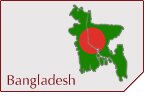
Bangladesh
Exporting to Bangladesh
Bangladesh's biggest asset is its plentiful supply of very cheap labour. The UK is historically the largest investor in Bangladesh, with around 50 companies operating in the market. Britain has traditionally been the biggest overseas investor in the country.
Companies from developed countries, the UK included, sell into the market on the basis of quality, or life-cycle cost, training and/or after-sales service.
This guide highlights some of the key features of the Bangladeshi market, and explains how you can start to win export business there. It also identifies sources of support to help you.
Sub Menu
Top of page 
ASSESS THE OPPORTUNITY TO TRADE WITH BANGLADESH
UK exports to Bangladesh up to November 2004 were £61 million, an increase of 20% on the same period in 2003. The main exports to Bangladesh are power generation equipment (10% of the total), general industrial machinery and dyeing, tanning and colouring materials. The UK has also been traditionally successful in the construction sector, especially bridge building and also in the consultancy and education sectors.
REGIONAL FOCUS
Dhaka, the capital and by far the largest city in Bangladesh, has grown to become the country's main commercial centre. The second city, Chittagong, is home to Bangladesh's largest seaport and a thriving business scene. Sylhet, Khulna and Bogra are the country's other commercial centres.
UNDERSTANDING BANGLADESH CUSTOMERS
Bangla (Bengali) is the official national language, but English is the key language for commerce. Most business people you deal with, when exporting, are likely to speak good English.
Bangladesh business culture tends to be formal and follows a hierarchical structure - for example business cards are exchanged after the initial introduction. It's normal practice to start meetings with small talk rather than getting straight down to business. A good rule of thumb in meetings is to follow your host's lead.
BUILDING RELATIONSHIPS
It is generally accepted that to do business in Bangladesh a foreign company needs to appoint an influential local partner (usually an agent), who knows how business is done and can navigate a path around Bangladeshi bureaucracy. The appointment of the right agent is considered to be fundamental to success.
Winning new business can take longer than you would like. You should be prepared to invest time and effort in building a long-term relationship.
For more information, see the section in this guide on marketing and selling in Bangladesh
TRADE VISITS TO BANGLADESH
Successfully exporting to Bangladeshi customers depends on building relationships, and often requires several face-to-face meetings. Trade visits can help you identify potential customers and key contacts, and find out what they think of your product. You can also use them to build relationships with local advisers and other key contacts.
Find out about trade visits and business opportunities on the events section of the website.
To make the most of trade visits, plan well in advance. Make sure you have a clear objective and organise all the support material you need. Try to make appointments with target contacts in advance, and reconfirm them shortly before you travel. Make sure you're speaking to people who make exporting decisions. If you have local agents, use their expertise. In an organised trade visit, the organisers should help you find contacts.
MARKETING AND SELLING IN BANGLADESH
To succeed in the Bangladeshi market, you need to compete with local, national and multinational businesses. As an exporter based in the UK, your costs are likely to be higher than those of many competitors. You therefore need to clearly demonstrate the value of what you offer. Superior technology and quality may give you an edge.
There are several ways to reach customers:
- Exporting directly can suit high value products or services. However winning new customers is likely to require significant investment in building relationships, and several visits.
- You may find it more cost-effective to work with a local agent or distributor.
- A joint venture with a local partner can be a way of accessing the Indian market, particularly in highly regulated sectors.
- Larger businesses, and increasing numbers of middle-market consumers, have Internet access.
You must be prepared to adapt your offering to suit Bangladesh market. Any advertising or other promotion should be adapted to suit Bangladeshi culture (for example imported goods and their containers must not incorporate any words, pictures or inscriptions of a religious or obscene connotation). You also need to take into account local product regulations.
FINANCING EXPORTS TO BANGLADESH
Bangladeshi companies purchasing imports generally need approval. If you are selling to an experienced importer, they should be able to advise you of the documentation they require.
Imports are generally financed using import letters of credit or import bills. These are promises from your customer's bank to make payment to you once the goods or services you export are received and the documentation covering the transaction is properly and correctly presented.
TAXES, DUTY AND LEGAL CONSIDERATIONS FOR EXPORTS TO BANGLADESH
In the UK, you must declare all exports to HM Revenue & Customs (HMRC). You also need to keep documentary evidence of exports, and record the value of exports on your VAT return. Exports of most products to Bangladesh are zero-rated for VAT. There are no additional export taxes.
Most goods can be freely exported to Bangladesh, though there are restrictions in areas such as goods with potential military use.
BANGLADESH TAXES AND REGULATIONS
There are some restrictions on imports - often to protect local businesses in particular sectors. Imports must comply with local regulations.
Bangladesh's regime of import or tariff duties is not considered to be unduly protectionist, in global terms. Rates of duty on more commonly imported items range from 25% (for textiles and clothing products competing in Bangladesh's key economic sector); for high energy-consuming home electrical and electronic items; and for motor cars) down to zero (for key inputs into the textiles and clothing industries; for fertilisers; and for many foodstuffs).
DUTY
When you export goods to Bangladesh, they will attract import duty. You or your local representative will have to pay this before the goods will be released by customs. The level of duty will depend on the type of product.
To find out the duties paid on goods exported to Bangladesh, you will need a 4 or 6 figure HS or Commodity Code number for your product, obtainable from the HM Revenue & Customs Tariff Classification Service Enquiry Line on Tel 01702 366 077.
Top of page  |