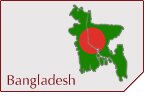
Bangladesh
High Value Added Consumer Products Sector Review
Definition and scale of sector
- Tableware ceramics,
- Jewellery,
- Crystal glass,
- Leather goods,
- Clothing, carpets
- General Engineering
- General Manufacturing
Why the sector was chosen in the West Midlands
- Longstanding concentrations of traditional consumer product industries in older urban core. Also craft based production an important component in some rural economies.
- Key influence played by design and marketing in the development of a future for these industries around improved value added opportunities.
- Process efficiency improvements important in sustaining volume manufacturers.
Top of page 
Ceramic machinery and materials sector - Bangladesh - A report from UKTI - April 2008
Historically the ceramic and tableware industry is labour intensive and given Bangladesh has a reasonable supply of gas and is a low labour cost economy it offers to be a strategic partner in the production and supply of ceramic products. Investment interests in this sector are strongly welcomed.
At present there are a number of different types of ceramic products being produced in the local market such as tableware, sanitaryware, insulator, tiles, float glass and tamla (drinking water glass). The Bangladesh Ceramic Manufacturers Association (BCMA) estimate that the current investment levels in the ceramic industry is roughly about Taka 5.0 billion (US$ 714 million).
Bangladesh is now exporting to over 48 countries including the European Union, Scandinavia and the United States while China, Poland, Thailand, Romania and Indonesia are its major competitors. In 2006-2007, Bangladesh exported ceramic products worth approximately US$32.80 million and imported finished products worth US$44.12 million.
Given this present scenario, UK companies could consider exploring the opportunities to take active part in the development of Bangladesh’s ceramic sector because of the following three main reasons. Firstly, there are opportunities to provide production design and facilities. Secondly, raw materials export. Thirdly, machinery supplies.
Source: UK Trade & Investment
FOR THE FULL REPORT PLEASE CLICK HERE
Textile Sector - A Report from UKTI - March 2008
Textiles is the largest export sector of the country and the fastest growing industry with ready made garments (RMG) accounting for more than 78% of total export earnings. Bangladesh is one of the top five RMG exporters in the world with annual exports of RMG over US$8.10 billion. The projected target by 2010 of RMG exports is US$10.00 billions.
Ministry of Textiles records shows that there are now 23 textile mills under government ownership. However, most of these mills are non-functional and the machinery is obsolete. Although the performance of public sector mills has declined over the years the private sector mills have flourished under the patronisation of the supportive policy of the successive governments.
In the private sector there are 247 spinning mills having a spindle capacity of 5.2 million, 356 weaving mills with a production capacity of 900 million metres of grey fabrics. A further 1137 million metres of grey fabrics are produced by semi mechanised/mechanised power looms and handloom units. The number of private RMG factories is estimated to be over 4000 units employing over 4.5 million of the industrial workforce. Defying all projection as losers under the quota free regime the Bangladesh RMG exports have shown as upward trend since 2005 and 2006. Some American buyers are shifting their orders from China to Bangladesh mainly due to restrictions imposed on Chinese products under WTO safeguard mechanism. Moreover, Bangladesh enjoys the duty-free market access benefits under the ''Generalised System of Preference (GSP)'' and Everything but Arms (EBA). She also enjoys duty free market access to Canada, Australia, Japan, Norway and other countries
Source: UK Trade & Investment
FOR THE FULL REPORT PLEASE CLICK HERE
Rise Of Readymade Garments Industry In Bangladesh: Entrepreneurial Ingenuity or Public Policy - November 2006
The 100 percent export-oriented readymade garments (RMG) industry of Bangladesh has witnessed remarkable growth since its inception in the late 1970s. Paradoxically, this flagship industry of Bangladeshi private entrepreneurial talent took roots through the first export consignment of shirts from Bangladesh made by the state-trading agency, the Trading Corporation of Bangladesh (TCB), in the mid-1970s under counter trade arrangements and the destination was some East European countries.
Subsequently, however, private entrepreneurs entered the industry and phenomenal growth took place in RMG exports from Bangladesh. Export of RMG increased from US $40 thousand in 1978 –79 to US $6.4 billion in 2004-05. The industry has also provided employment to nearly 2 million workers, most of them women drawn from the rural areas.
Source: Mohammed Ali Rashid, Professor of Economics, North South University, Bangladesh
FOR THE FULL REPORT PLEASE CLICK HERE
End of MFA Quotas: Key Issues and Strategic Options for Bangladesh Readymade Garment Industry - January 2006
”With the removal o f MFA quotas, there will be opportunities to expand market shares, but also tough competition for markets. The challenge i s not to protect a special position, but to open up the markets and ensure that Bangladesh will be in a strong position to compete.”’
This study addresses that challenge. It examines the factors that have brought Bangladesh such impressive success as a producer and exporter of ready-made garments (MG) in a quota-based trading regime. I t explores the likely threats to that success as the post-MFA trade regime becomes intensely competitive. And it sets out a number of strategic options for the sector to pursue, building on past achievements and inherent competitive advantages, in order to compete successfully in textile and apparel markets under new and very demanding conditions.
Source: The World Bank
FOR THE FULL REPORT PLEASE CLICK HERE
Top of page  |